
LAB RESULTS
What Lab Was Used?
The CTT Group of St-Hyacinthe, Quebec, Canada.
What Was Tested?
A 6.7 lb 100% Alpaca ThunderCloud Saddle Blanket and a 5 Star 3/4" F10 pad.
The impact tower tests realistically mimicked real-life situations, meaning the impacts received by the horse on an area of approximately 2 to 3 square inches (the front area of the saddle tree bars) with a saddle weighing an average of 42 pounds and a rider weighing an average of 265 pounds. These conditions simulate the lateral movements typical of cutting work or stopping in a sliding stop with rebounds. The following imformation is a straightforward explanation provided by a lab technician at CTT Group.
“Compression Deflection” test (page 1):
The figure we're focusing on is 1.48 psi, representing the average energy needed to compress the material by 25%, compared to the 8.23 psi required by the 5 Star pad. This indicates that a ThunderCloud Saddle Blanket dissipates about six times more energy.
“Compression Set” test (page 2):
The average Compression Set (%) for the ThunderCloud Saddle Blanket indicates that only 8.02% of its thickness is lost after 50% compression over 22 hours. Once again, the Alpaca ThunderCloud Saddle Blanket pad outperforms the 5 Star pad, which experiences a 16% loss.
Force Reduction" test using the impact tower (page 3):
This test highlights three aspects: the shock absorption rate, which is quite similar between both products; the deformation of the materials under impact, also largely comparable; and the energy restitution. Approximately 47% of the energy is lost through deformation, transmission within, or passing through the material, while 53% is reflected as rebound energy (protection). To precisely assess the energy transmitted to the horse, additional measurements of the impact-absorbing object are required. dissipation, deand/or passing through it, while 53% is rebound energy (protection). To accurately determine the energy transmitted to the horse, further measurements of the object receiving the impacts are necessary.
During the ASTM F3189 test, the equipment applies an impact with a 20 kg (44 lb) mass launched at approximately 0.98 m/s — or about 3.5 km/h (2 miles/h).
During this impact, the maximum measured force reaches approximately 4,000 N. This is roughly equivalent to the weight of a mass of about 400 kg (882 lbs) when placed vertically on a surface. It's important to clarify that this is a maximum force applied for a very short time, and not a static load of 400 kg maintained continuously.
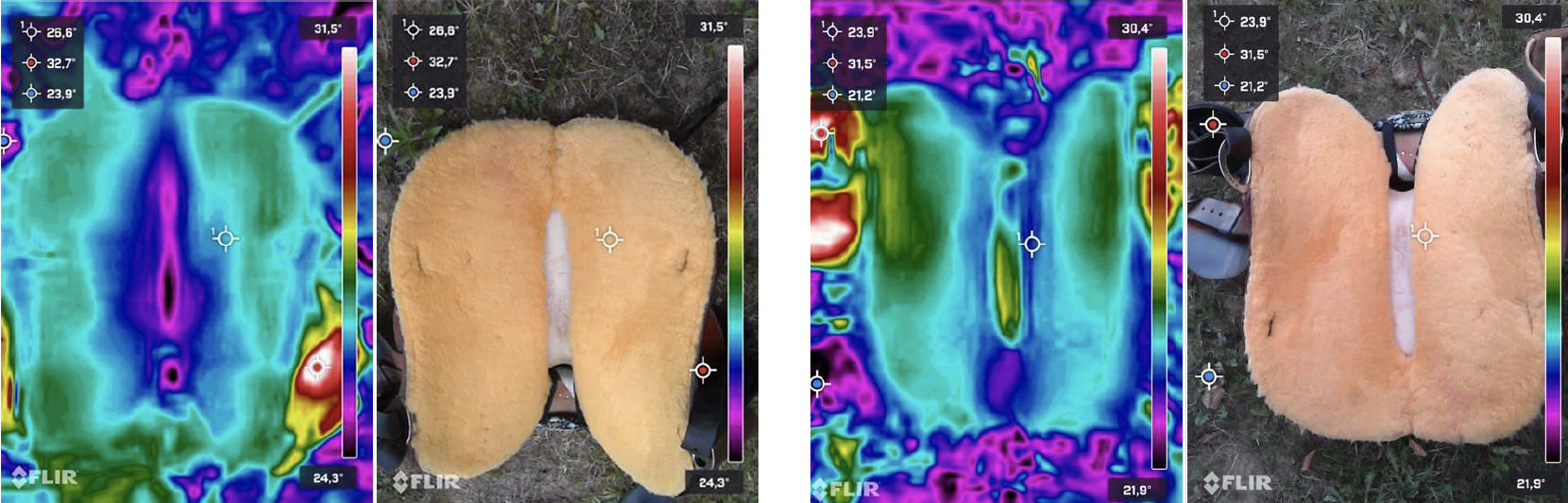
Blanket images: Top view of the Mohair and Alpaca blankets
The broad, even red-white area shows how friction and pressure zones are spread out. The heat is distributed evenly, suggesting the weight is balanced, and the saddle fits properly.
The green-yellow area at the withers shows that pressure and friction are fully released in this region.
The red and white area along the lower edge of the blanket, which is a bit more pronounced on the Mohair, is due to the extra thickness of a custom tooled wear leather attached by Yves Lesire. This custom wear leather is not standard with a ThunderCloud.
The heat distribution across the blanket is even, so the pressure during use is distributed well, with no concentrated hot spots that could cause discomfort or injuries to the animal.
Spinal freedom: The absence of hot spots along the spine indicates that neither the saddle nor the blanket is applying direct pressure to this sensitive area. This is key to preventing back pain or irritation. Withers clearance: The withers, a particularly delicate spot, also remain free. No excess heat in this region indicates the blanket and saddle fit the horse’s shape well, avoiding any risk of pinching or rubbing.
The same temperature differences observed earlier in the saddle images are evident here, highlighting the Alpaca blanket’s superior ability to dissipate heat. In terms of even pressure distribution, both blankets perform equally well. The minor pressure variations seen in the saddle’s thermal images are absent in the blanket images, indicating that both blankets provide sufficient cushioning to absorb pressure issues caused by rider imbalance. The thermal photo clearly demonstrates that the blanket fits well: both pressure and heat are evenly distributed, and the horse’s spine and withers are protected. This setup enhances the horse’s comfort and helps prevent injuries from uneven weight distribution.
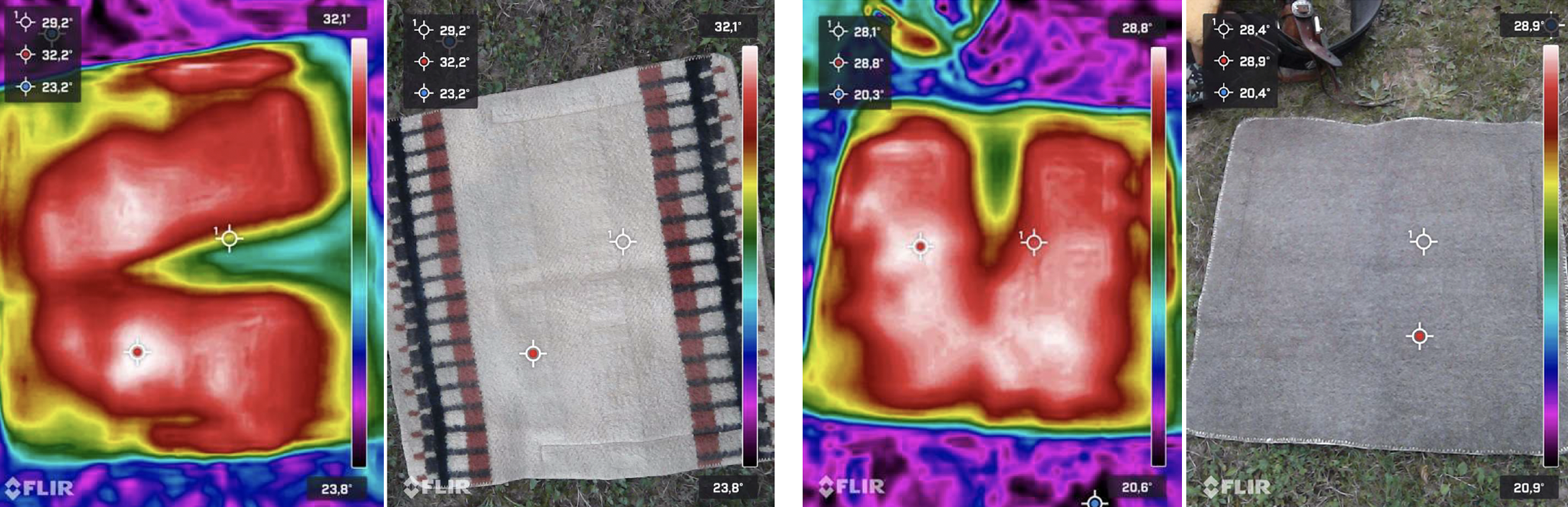
Comparison with a thin Neoprene saddle pad
Thermal imaging highlights significant friction zones, especially around the shoulders and at the rear of the saddle near the horse’s thoracic vertebrae.
The pressure distribution isn’t even, which can lead to hot spots or discomfort during extended training sessions.
A slight left/right imbalance can be observed, likely caused by the rider’s own imbalance and less effective compensation by the pad.
The withers remain clear and unobstructed.
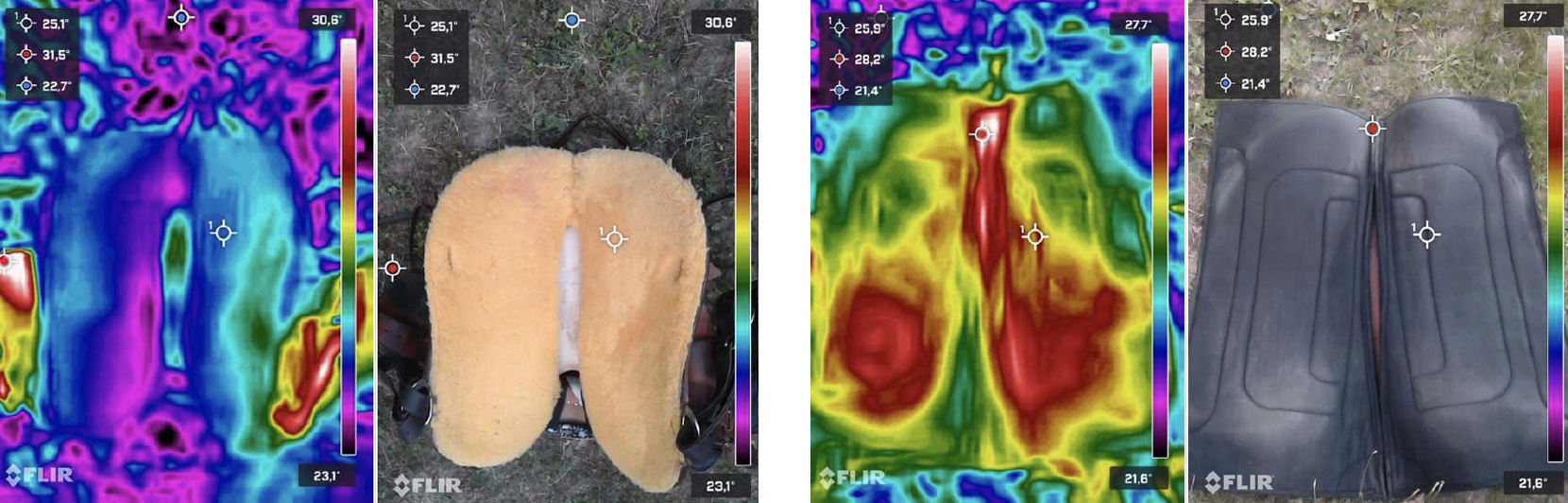
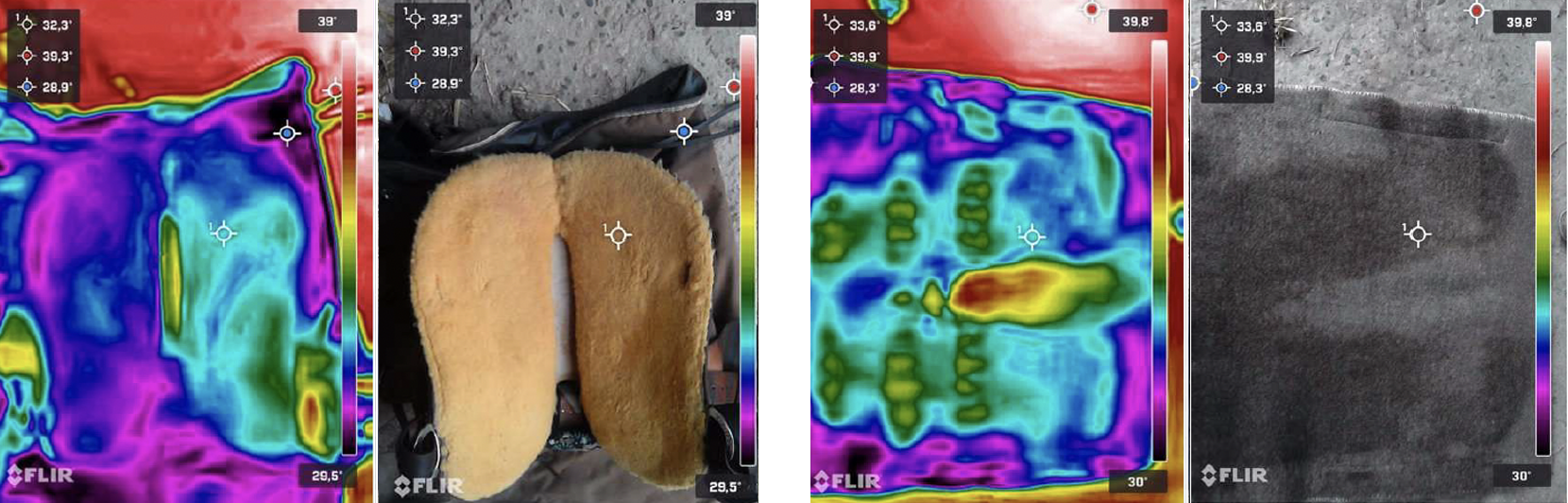
Thundercloud Alpaca saddle blanket trial on a two-hour ride across varied terrain
The horse was ridden at the walk, trot, and canter by the same imbalanced rider with the knee issue.
This test was carried out in extremely hot 95°F weather. It was late in the day, with the sun hidden behind the hills, so there was no direct sunlight. The mare came back soaking wet.
You can clearly see the heat-release channel along the saddle’s gullet. Both the blanket and the saddle maintained a reasonable temperature, with the ground appearing as the hottest spot in the thermal images. The green and yellow bands in the blanket’s image are caused by heavier sweating in some intercostal regions, as the mare is currently quite overweight. Images from both sides show that the area under the saddle is cooler than the rest of the horse’s body, demonstrating strong heat dispersion and ventilation—great for the horse’s comfort and injury prevention. The coldest areas are along the withers and spine, indicating they are well protected from pressure and rubbing. The saddle’s pressure points are actually cooler than the surrounding zones, further proving how effectively the blanket dissipates heat.
Summary
The ThunderCloud Saddle Blanket does an outstanding job of distributing pressure and heat evenly. It safeguards sensitive areas like the withers and spine, making a real difference in your horse’s comfort. The effectiveness of the Alpaca blanket was clearly demonstrated during the two-hour trial.
In terms of saddle stability, the Alpaca and Mohair blankets delivered better steadiness than the wool felt pad, though not quite as much as the neoprene. When it comes to how the horse feels and moves, ThunderCloud Saddle Blankets are noticeably superior to the other pads typically used with the mare, which is a big plus.

Nelly Rivoire (Holistic Animal Therapist)
Equipment used: FlirT camera for iOS.
Test carried out on Game Night Wolf Hill, a 9-year-old Irish Cob cross, fitted with a custom Yves Lesire saddle made two years ago.